
Gallatin Projected Versus Actual Release
A projected release date is a forecast built from the sentence and the corrections data available at that time. An actual release date records a completed custody event. The two should not be swapped. Kentucky Offender Online Lookup, or KOOL, offers an exact “Projected Release Date From/To” search filter for state offenders, but the field does not prove that a person walked out.
A Gallatin defendant held before trial may have no computed sentence date. Release can depend on bond being posted, all holds clearing, and the jail finishing the order. A judge's bond order establishes legal authority, not the exact moment Carroll County Regional Detention Center completes processing. For a sentenced state prisoner, KOOL and the KYDOC sentence record are the right route.
Transfers also matter. A name can leave Carroll's current roster because the person entered KYDOC custody. In that event, the local roster change is not a community release, and KOOL may later show an institution or supervision district.
Find Gallatin Projected Release Dates
Identify the custody class before searching. KOOL covers Kentucky state offenders, not every short Gallatin jail stay. The Carroll facility and Gallatin court file answer local custody and sentence questions. Federal and immigration cases use other systems.
- Check Carroll's current list only to learn whether the person remains displayed. A no-result is not a release date.
- For a state offender, open KOOL and search with minimal reliable name or identifier data.
- Use advanced criteria, including Projected Release Date From/To, supervision status, location, county of supervision, or DOC/PID number when they help narrow the match.
- Open the detail record and distinguish an institution from a community supervision district.
- For a local sentence or pretrial case, contact Carroll and inspect the Gallatin court docket for sentence, jail credit, bond, or release orders.
- Request the sentence-calculation or release record when the public fields conflict or lack needed detail.
The Gallatin County released-inmate search provides the broader county path. For a projection dispute, note the date KOOL was checked and ask KYDOC for the current sentence-calculation sheet rather than asking staff to create new arithmetic.
Note: KOOL advises that data is updated daily, yet records newer than 120 days may not be finalized.
Kentucky Credits Shape Gallatin Release Dates
KRS 197.045 provides Kentucky's sentence-credit framework. The research identifies required, discretionary, and forfeitable credit categories. Educational or program credits can depend on eligibility and completion, while disciplinary action can cause credit loss. Consecutive sentences and the order in which credits apply can also change the calculation.
The common 85-percent phrase is not a rule for every person. KRS 439.3401 applies an 85-percent parole-eligibility rule to covered violent offenders, subject to the statute and applicable version. It should not be used as a shortcut for ordinary cases. Offense date, conviction type, sentence structure, and transition provisions may control.
Parole eligibility is also not a release date. A Board hearing may occur before the true eligibility date, and a favorable action can still be followed by conditions or processing. Mandatory reentry supervision under KRS 439.3406 is another distinct way a person may enter the community before final discharge.
- Sentence credit
- Time credited under law or authorized programs against a sentence calculation.
- Parole eligibility
- The point at which parole consideration may occur, not a guaranteed exit.
- Detainer
- A request or hold from another authority that may prevent community release.
- Mandatory reentry
- A statutory form of community supervision before the sentence fully ends.
Why Gallatin Release Dates Move
A projection can change without error. It may reflect new facts entered after the first calculation. The public field should be read alongside current location, status, sentence details, and later legal events.
| Factor | Possible effect | Best confirming source |
|---|---|---|
| Credit earned or forfeited | Moves the computed date earlier or later | KYDOC sentence-calculation record |
| Discipline | Can cause loss of forfeitable credit | KYDOC record |
| New or consecutive sentence | Changes aggregate time | Court judgment and KYDOC calculation |
| Detainer or hold | May prevent release to the community | Facility transfer/release record |
| Court order | Can alter sentence or release authority | Gallatin or sentencing-court docket |
| Parole action | Can lead to release, deferment, or serve-out | Board record, KOOL, and VINE |
A date in the past with no released status demands more review. Credits may have been forfeited, a sentence recalculated, or another hold applied. If KOOL still shows an institution, describe the date as an unexplained or outdated projection and ask KYDOC for the current calculation.
Confirm Gallatin Actual Release Dates
Kentucky VINE can report custody events for county jails and state prisons. Register on the matched local-jail and DOC entries when both exist. The Gallatin County VINELink check explains the name and ID search, duplicate-record issue, and notification channels.
An alert is a prompt to verify. Call Carroll for a regional-jail event, use KYDOC for a state-prison event, and compare the Gallatin court file when local release authority matters. A court order may predate the physical exit because bond, holds, and processing remain unresolved.
For a durable state record, request the offender summary, sentence-calculation sheet, actual release or discharge date, release authority, facility released from, and supervision begin or end status. For a Carroll event, seek the existing booking and release sheet. State which Gallatin case and approximate custody window identify the record.
Note: “Released” can mean physical custody ended while parole, probation, or mandatory reentry supervision remains active.
Kentucky Release Computation Is Individual
Kentucky credits are not one flat subtraction. Required, discretionary, and forfeitable categories can interact with sentence structure, offense rules, and later conduct. That is why a KOOL projected date may move even when a person's imposed sentence did not change. The governing statute version can also depend on when the offense occurred.
The 85-percent shorthand belongs only to offenders covered by the violent-offender statute. Applying it to every Gallatin County sentence would produce false dates. Mandatory reentry under KRS 439.3406 is a separate path into the community and does not equal final discharge.
The safest wording identifies the source and time of observation: KOOL displayed a projected date when checked, or KYDOC supplied a calculation dated on a stated day. Do not publish home-made sentence arithmetic as an agency result.
The successful manifest image that matches this topic comes from the current KRS Chapter 439 source.
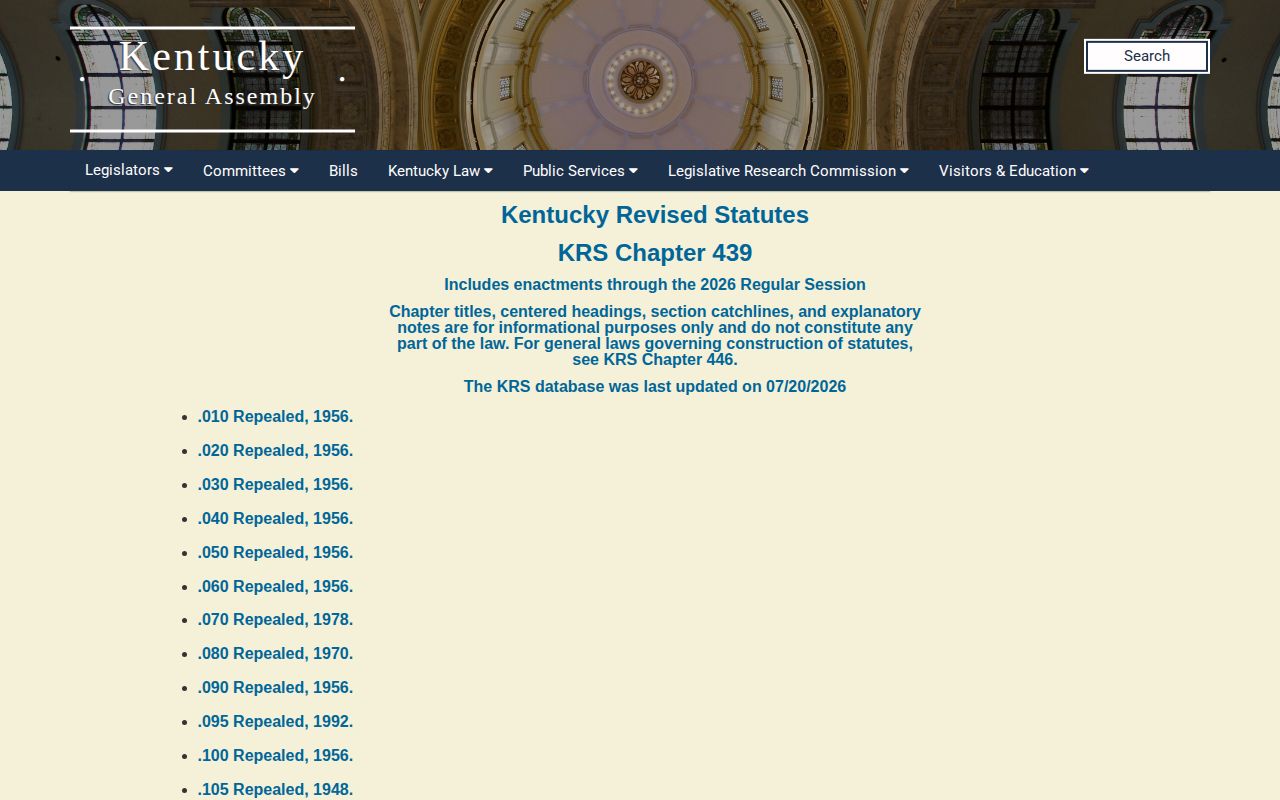
The statute view anchors the limited violent-offender rule and mandatory reentry distinction that must be checked before interpreting a projected date.
Gallatin Release Sources by Custody
The same name can require different systems. A Gallatin pretrial defendant housed at Carroll needs the jail and court path. A sentenced Kentucky prisoner needs KOOL and KYDOC. A federal sentenced inmate uses the BOP locator, while a federal pretrial release may require the court docket and USMS records. ICE's locator is mainly a current-custody tool, so no result does not prove release.
| Custody class | Projection source | Actual-release proof |
|---|---|---|
| Gallatin pretrial | Often no fixed date | Carroll release sheet plus court authority |
| Local sentenced stay | Facility and sentencing court | Carroll release record |
| Kentucky state prisoner | KOOL and KYDOC calculation | Updated status and KYDOC release record |
| Federal sentenced prisoner | BOP locator | BOP released status and date |
Never use the Carroll current roster as a projected-date archive. It is labeled Current Inmates, has no published release archive, and states no post-release retention period.